Upsc insights
Welcome to my UPSC learning space — where I share clear, concise, and thoughtful blogs on Polity, History, Geography, and Economics. Learn, revise, and stay inspired for your civil services journey.
Welcome to my UPSC learning space — where I share clear, concise, and thoughtful blogs on Polity, History, Geography, and Economics. Learn, revise, and stay inspired for your civil services journey.
Welcome to my UPSC learning space — where I share clear, concise, and thoughtful blogs on Polity, History, Geography, and Economics. Learn, revise, and stay inspired for your civil services journey.
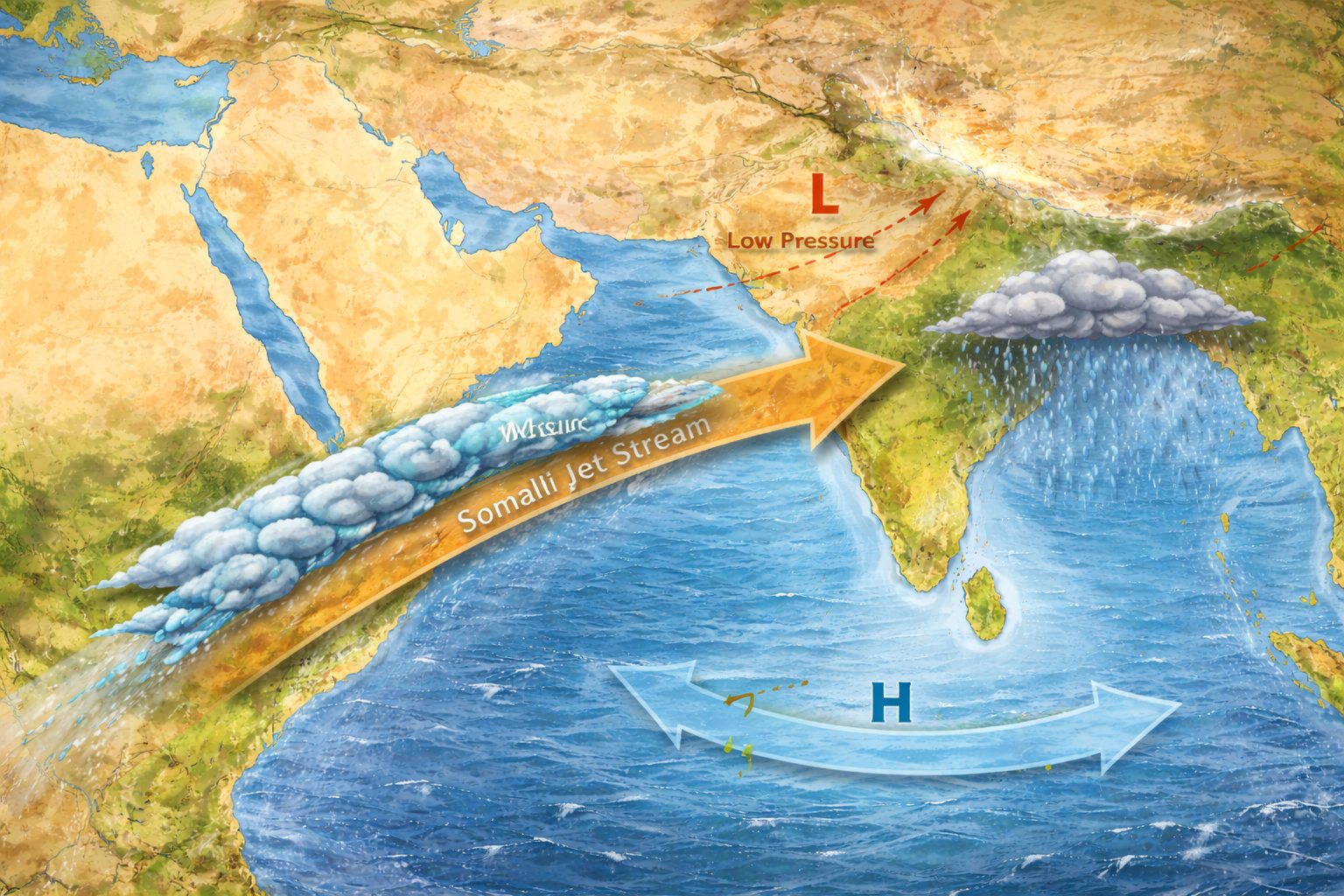
The role of Somali jet stream in the formation of Indian monsoon is one of the most important atmospheric processes that influences rainfall over the Indian subcontinent. Every year, millions of people depend on the monsoon for agriculture, water supply, and economic stability. But the monsoon does not occur randomly. It is driven by several atmospheric systems, and one of the most powerful among them is the Somali Jet Stream.
Understanding how this jet stream works helps explain how the southwest monsoon forms, intensifies, and brings heavy rainfall to India.
The Somali Jet Stream, also called the Low-Level Jet (LLJ), is a strong wind current that flows over the western Indian Ocean near the coast of Somalia.
It develops during the summer months and flows from the southern hemisphere toward the Indian subcontinent. The winds move at a high speed of around 40–60 km per hour, carrying a large amount of moisture from the ocean.
These moisture-laden winds eventually reach India and contribute to the formation of the southwest monsoon winds.
The jet stream is named after the East African country Somalia because the winds accelerate near its coastline before turning toward the Arabian Sea and India.
The formation of the Somali jet stream is closely connected with the seasonal heating of land and ocean.
During the summer months, the landmass of India heats up much faster than the surrounding oceans. This intense heating creates a low-pressure area over northern India and the Tibetan Plateau.
At the same time, relatively higher pressure exists over the southern Indian Ocean.
Air always moves from high pressure to low pressure. Because of this pressure difference, strong winds start blowing from the southern hemisphere toward the Indian subcontinent.
As these winds cross the equator, the Coriolis force changes their direction, causing them to flow as southwesterly winds over the Arabian Sea. Near the coast of Somalia, the winds accelerate dramatically and form the Somali Jet Stream.
The role of Somali jet stream in the formation of Indian monsoon is extremely important because it performs several key functions that help initiate and strengthen the monsoon.
One of the main roles of the Somali jet stream is transporting moisture from the Indian Ocean to the Indian subcontinent.
As the jet stream flows across the Arabian Sea, it picks up large quantities of water vapor. This moisture is then carried toward the western coast of India.
When these moisture-laden winds reach the land and encounter mountains such as the Western Ghats, they rise upward and cool, leading to heavy rainfall.
This process plays a crucial role in the onset of the southwest monsoon.
Another important role of the Somali jet stream is that it strengthens the southwest monsoon circulation.
The strong winds help maintain the flow of moist air toward India throughout the monsoon season. Without this jet stream, the monsoon winds would be weaker and rainfall would decrease significantly.
Meteorologists often monitor the intensity of the Somali jet to predict how strong the monsoon might be in a particular year.
The Somali jet stream also influences when the monsoon begins in India.
Usually, the southwest monsoon reaches the southern coast of India, especially Kerala, in early June. A strong Somali jet helps push the moisture-laden winds faster toward the Indian subcontinent, triggering the monsoon onset.
If the jet stream is weak or delayed, the arrival of the monsoon can also be delayed.
The jet stream plays a major role in enhancing rainfall along the west coast of India.
As the strong winds bring moisture continuously from the Arabian Sea, they create conditions for intense precipitation. This is why regions such as Konkan Coast and the Western Ghats receive some of the heaviest rainfall during the monsoon season.
In fact, the interaction between the Somali jet and coastal mountains significantly increases rainfall intensity.
Although the Somali jet stream is very important, the Indian monsoon is influenced by multiple atmospheric systems.
Some other important factors include:
The Mascarene High is a semi-permanent high-pressure system located over the southern Indian Ocean near Mascarene Islands.
This high-pressure system helps drive cross-equatorial winds toward India. These winds later strengthen into the Somali jet stream.
The heating of the Tibetan Plateau during summer creates strong low pressure in the upper atmosphere. This thermal contrast between land and ocean supports the development of the monsoon circulation.
The monsoon trough, a low-pressure belt extending across northern India, helps organize rainfall systems once the monsoon arrives.
The Somali jet stream supplies moisture to this system, which then produces widespread rainfall across the country.
Meteorologists closely observe the Somali jet stream because it helps in predicting the strength of the Indian monsoon.
A strong jet stream generally indicates:
On the other hand, a weak Somali jet may lead to reduced rainfall or monsoon variability.
Weather agencies such as the India Meteorological Department regularly monitor wind patterns over the Arabian Sea to assess the behavior of the monsoon.
The role of Somali jet stream in the formation of Indian monsoon also has major economic importance.
Nearly half of India’s agricultural land depends on monsoon rainfall. Crops such as rice, cotton, and pulses rely heavily on seasonal rains.
If the Somali jet stream is strong, it can support a healthy monsoon season, which benefits farmers and increases agricultural productivity.
However, if the jet stream weakens, rainfall may decrease, affecting crop production and water availability.
Understanding the Somali jet stream is essential for scientists, meteorologists, and policymakers.
It helps in:
Since climate patterns are changing globally, studying these atmospheric systems has become even more important.
“Climate scientists explain that low-level jet streams over the Indian Ocean significantly influence monsoon circulation.
The role of Somali jet stream in the formation of Indian monsoon is central to the entire monsoon mechanism. By transporting moisture, strengthening monsoon winds, and influencing rainfall patterns, this powerful wind current plays a crucial part in shaping India’s climate.
From the coast of Somalia to the western coast of India, the jet stream acts as a natural atmospheric bridge that carries life-giving moisture to the subcontinent.
Understanding this phenomenon not only improves weather forecasting but also helps societies prepare better for the opportunities and challenges of the monsoon season.


[…] Understand how somali jet helps in the formation of indian monsoon […]
[…] How Somali jet plays the role in the formation of indian monsoon […]