Upsc insights
Welcome to my UPSC learning space — where I share clear, concise, and thoughtful blogs on Polity, History, Geography, and Economics. Learn, revise, and stay inspired for your civil services journey.
Welcome to my UPSC learning space — where I share clear, concise, and thoughtful blogs on Polity, History, Geography, and Economics. Learn, revise, and stay inspired for your civil services journey.
Welcome to my UPSC learning space — where I share clear, concise, and thoughtful blogs on Polity, History, Geography, and Economics. Learn, revise, and stay inspired for your civil services journey.
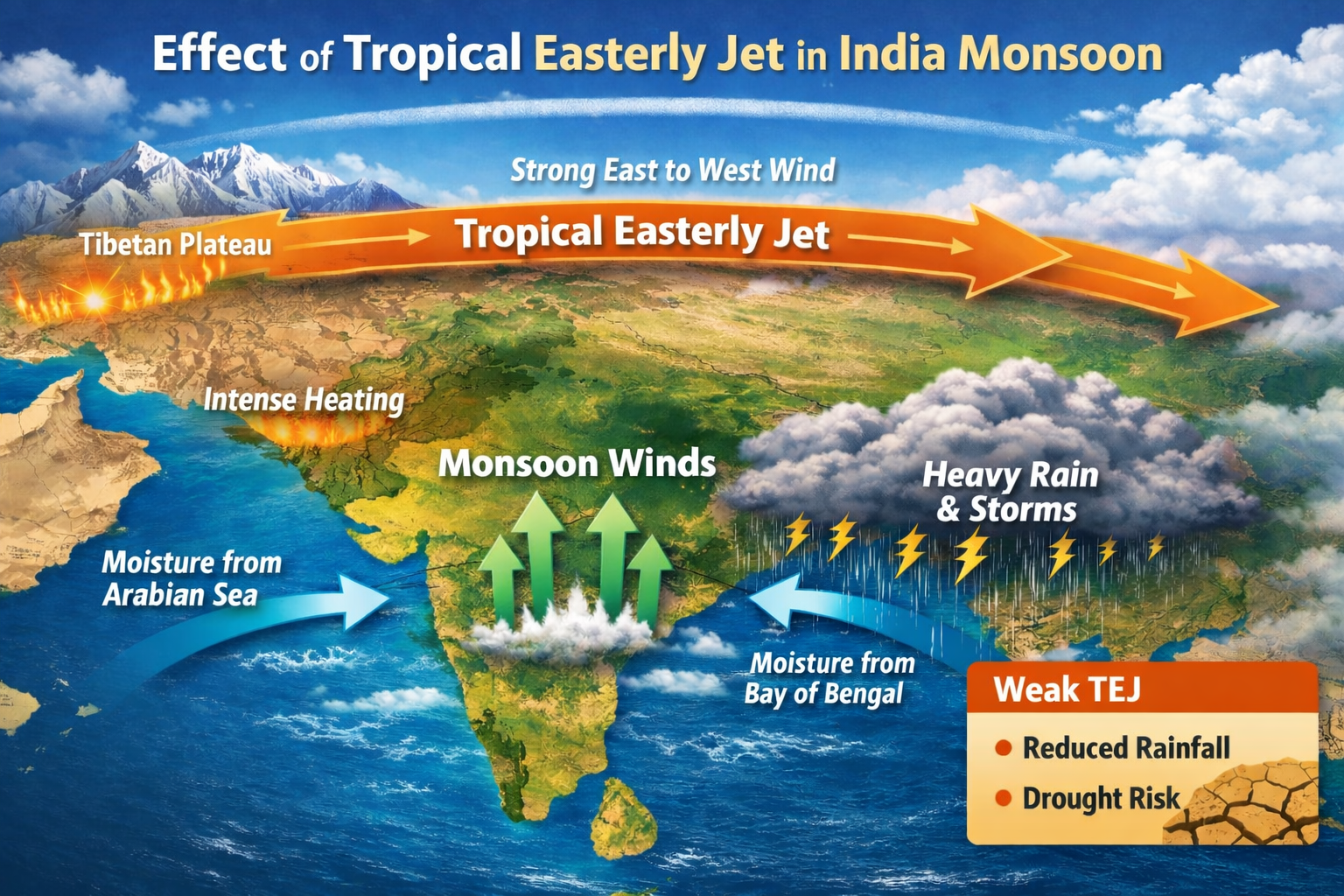
The Indian monsoon is one of the most complex weather systems in the world. Many atmospheric factors work together to bring rainfall to the Indian subcontinent. Among these, the Tropical Easterly Jet (TEJ) plays a crucial role during the monsoon season. Understanding the effect of tropical easterly jet in India monsoon helps explain why rainfall patterns vary across regions and why some years experience stronger or weaker monsoons.
In this article, we will explore what the Tropical Easterly Jet is, how it forms, and its direct impact on the Indian monsoon system.

The Tropical Easterly Jet (TEJ) is a fast-moving stream of air that flows from east to west in the upper troposphere, typically around 12–15 km above the Earth’s surface.
This jet stream develops mainly during the Northern Hemisphere summer, especially between June and September, which coincides with the Indian southwest monsoon season.
Key characteristics of the Tropical Easterly Jet include:
The TEJ is strongly linked to the intense heating of the Tibetan Plateau and the surrounding landmass during summer.
The formation of the TEJ is closely related to large-scale atmospheric circulation over Asia and the Indian Ocean.
During summer, the Tibetan Plateau becomes extremely hot because it lies at a very high altitude. This intense heating creates a strong upper-level high-pressure system over the region.
The heating over Asia and comparatively cooler temperatures over the Indian Ocean create a pressure difference in the upper atmosphere. This pressure gradient initiates strong east-to-west winds.
As a result, a powerful Tropical Easterly Jet stream forms across South Asia, extending from Southeast Asia across India toward Africa.
This upper-level jet becomes one of the defining atmospheric features of the monsoon circulation.
The effect of tropical easterly jet in India monsoon is significant because it directly influences rainfall intensity, monsoon stability, and regional precipitation patterns.
Let’s understand its major impacts.

One of the most important effects of the Tropical Easterly Jet is that it strengthens the southwest monsoon circulation.
The TEJ enhances upper-level divergence in the atmosphere. When air diverges at higher altitudes, it allows rising moist air from the lower atmosphere to continue ascending. This vertical movement promotes the development of monsoon clouds and rainfall.
As a result:
A strong Tropical Easterly Jet is therefore usually associated with a healthy and active monsoon season.

The TEJ also plays a key role in maintaining deep convection, which is essential for heavy rainfall.
When the upper atmosphere allows air to move outward efficiently, it reduces atmospheric pressure at lower levels. This encourages warm and moist air to rise rapidly, forming large cumulonimbus clouds.
These clouds are responsible for:
Without the support of upper-level jets like the TEJ, convection would weaken and rainfall could decrease.

The presence of the Tropical Easterly Jet is also linked to the timely onset of the Indian monsoon.
Meteorologists observe that:
Therefore, the TEJ acts as an indicator of monsoon strength and progression.
The TEJ significantly influences where rainfall occurs within India.
Its strongest core is usually located over peninsular India, particularly:
Regions located under the strongest part of the jet often experience:
On the other hand, if the jet shifts north or south, rainfall distribution across India may change.
A weak Tropical Easterly Jet can negatively affect the monsoon system.
When the TEJ weakens:
This can result in:
Several studies have found that weak TEJ years often correspond with below-normal monsoon rainfall in India.
AS OF NOW YOU HAVE UNDERSTAND THE EFFECT OF TROPICAL EASTERLY JET ON INDIAN MONSOON , UNDERSTAND HOW SOMALI JET PLAYS A ROLE IN IN INDIAN MONSOON
To fully understand the effect of tropical easterly jet in India monsoon, it is important to compare it with another major jet stream: the Subtropical Westerly Jet (STWJ).
Key differences include:
| Feature | Tropical Easterly Jet | Subtropical Westerly Jet |
|---|---|---|
| Wind Direction | East to West | West to East |
| Season | Summer | Winter |
| Role | Supports monsoon rainfall | Suppresses monsoon |
| Location | South of the Himalayas | North of the Himalayas in summer |
Before the monsoon begins, the Subtropical Westerly Jet shifts northward. This shift allows the Tropical Easterly Jet to develop, creating favorable conditions for monsoon circulation.
Meteorologists closely monitor the Tropical Easterly Jet because it provides valuable clues about the upcoming monsoon season.
The strength, position, and speed of the TEJ help scientists:
Satellite observations and weather models now track the TEJ continuously to improve monsoon predictions.
The effect of tropical easterly jet in India monsoon is profound and multi-dimensional. This upper-level jet stream plays a crucial role in strengthening monsoon circulation, enhancing cloud formation, and influencing rainfall distribution across the country.
A strong Tropical Easterly Jet usually supports a vigorous and well-distributed monsoon, while a weak jet can lead to reduced rainfall and monsoon breaks. Because of its influence on atmospheric dynamics, the TEJ remains one of the most important features studied by meteorologists while analyzing the Indian monsoon system.
Understanding the Tropical Easterly Jet not only helps explain the behavior of the monsoon but also improves our ability to forecast rainfall patterns that affect agriculture, water resources, and the overall economy of India.
The Tropical Easterly Jet (TEJ) is a strong upper-level wind current that flows from east to west across South Asia during the summer monsoon season.
The Tropical Easterly Jet occurs in the upper troposphere, usually between 12 and 15 km above the Earth’s surface, around the 100–200 hPa pressure level.
The effect of tropical easterly jet in India monsoon includes strengthening monsoon winds, enhancing rainfall through upper-level divergence, and supporting deep convection that produces heavy rain.
The Tropical Easterly Jet forms during summer months (June to September) due to intense heating over the Tibetan Plateau and surrounding land areas.
A weak Tropical Easterly Jet can lead to:


[…] Tropical Easterly Jet forms south of the Tibetan […]